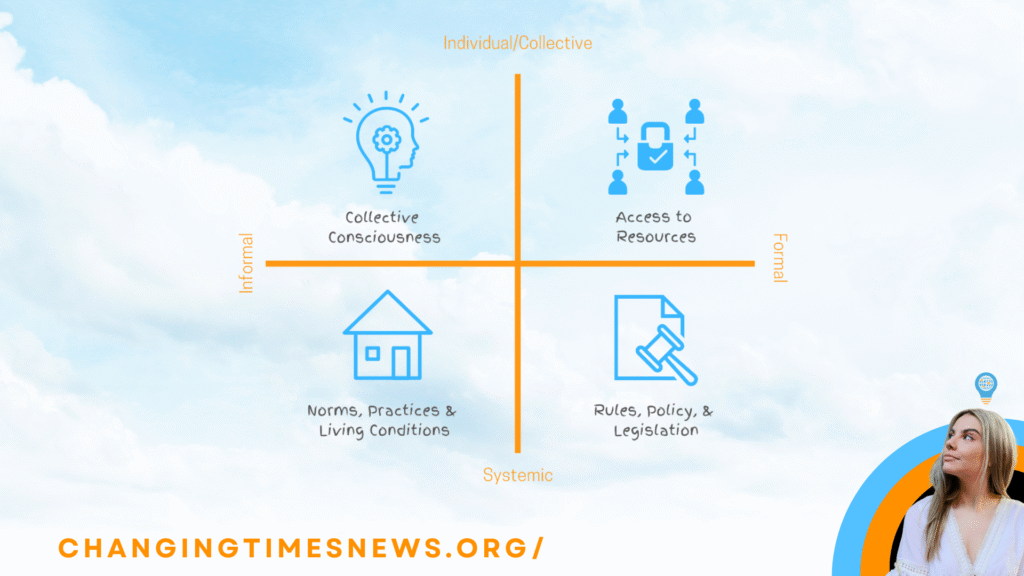
Across movements for justice, sustainability, and equity, a common frustration emerges: the feeling that change is not happening fast enough, or worse, that progress is going backwards. This perception can be deeply demoralising for those working in social change spaces, particularly when effort, urgency, and moral conviction appear to yield limited visible results.
Yet this frustration often rests on a misunderstanding of how social change actually unfolds. Change is not a single event, nor a linear process marked by steady forward motion. It is a dynamic, ongoing transformation shaped by multiple forces operating at different speeds and scales.
Understanding this complexity is not an exercise in resignation. Rather, it is essential for sustaining long-term engagement, avoiding burnout, and designing interventions that endure.
Change Is Always Happening — Even When It Is Hard to See
One of the most persistent misconceptions about social change is the idea that it only counts when outcomes are immediately visible. When desired reforms stall, policies regress, or public sentiment shifts, it can feel as though change has stopped altogether.
In reality, change is constant. At any given moment, societies are shaped by three simultaneous processes: emergence, continuity, and discontinuity. New ideas, practices, and relationships are forming; long-standing structures and norms are being reproduced; and certain arrangements are eroding or disappearing.
These processes occur regardless of whether they align with our hopes or timelines. What often creates the illusion of stagnation is a narrow focus on outcomes rather than conditions. While headline reforms may falter, underlying shifts in culture, relationships, and consciousness may still be taking place beneath the surface.
Moving Beyond Linear Thinking About Progress
Much of the despair associated with slow change stems from linear models of progress. In these models, societies are imagined as moving either forwards or backwards along a single trajectory. When setbacks occur, they are interpreted as reversals rather than recalibrations.
A more accurate approach recognises change as non-linear. Social systems do not evolve in straight lines. They adapt, resist, rupture, and reorganise in response to internal and external pressures. Conditions are never identical from one moment to the next, even when outcomes appear similar.
This perspective reframes setbacks not as failures of change itself, but as evidence that change is contested terrain. History shapes present conditions, but it does not determine the future. New possibilities continually emerge from within existing systems.
Social Transformation Operates on Different Timescales
When people speak about social change being slow, they are often referring to social transformation — the creation of conditions that are qualitatively different from those that existed before. Transformative change involves shifts in institutions, cultural norms, collective values, and power relations. These shifts do not occur overnight.
Short-term changes certainly matter. Policy wins, campaigns, pilot programs, and moments of heightened visibility can have real and immediate impacts. However, these faster-moving elements exist within a broader context shaped by much slower processes.
Confusing short-term momentum with long-term transformation can lead to unrealistic expectations and strategic misalignment. Sustainable change requires patience precisely because it aims to reshape the foundations of social life.
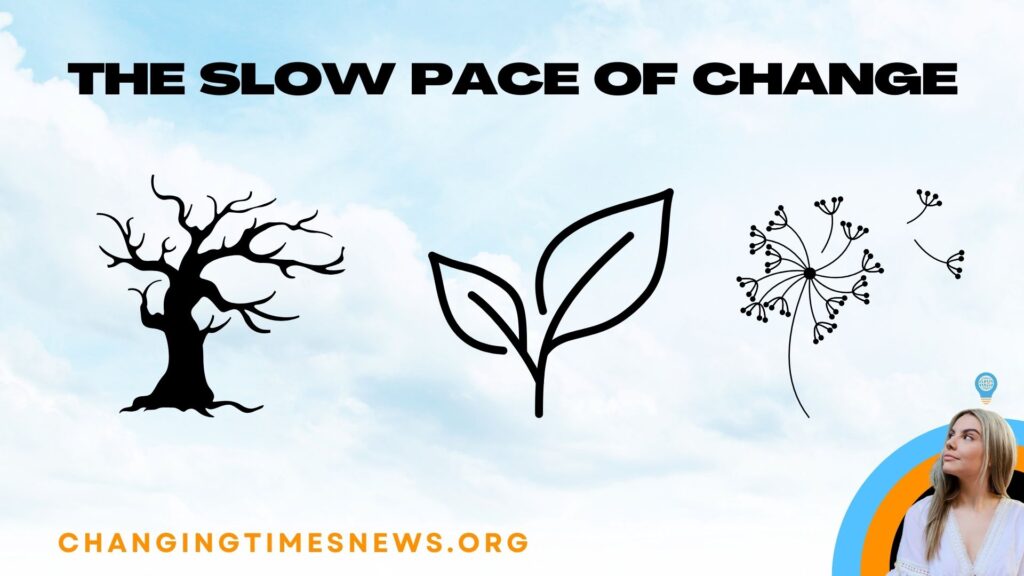
The Forest as a Metaphor for Social Change
An ecosystem metaphor offers a useful way of understanding how different forms of change coexist.
In a forest, towering trees provide structure and stability. They grow slowly, over decades or centuries, and once established, they define the conditions of the entire ecosystem. In social systems, these trees resemble institutions, laws, cultural norms, and deeply embedded belief systems.
Beneath the canopy, faster-growing plants — shrubs, vines, ground covers — fill the forest floor. They change with the seasons, respond quickly to environmental shifts, and are highly visible. These represent everyday practices, community initiatives, businesses, and short-term interventions.
Then there are weeds: invasive species that emerge where systems are neglected or stressed. In social terms, these are the setbacks, regressions, and unintended consequences that arise during periods of transition.
Each element plays a role. Focusing only on the fast-growing plants risks mistaking surface activity for structural change. Attempting to remove weeds without addressing underlying conditions ensures they will return. And cutting down the trees without preparing replacements creates instability rather than progress.
Why Deep Change Cannot Be Rushed
Institutions and cultures are slow to change because they are designed to endure. They are supported by habits, incentives, identities, and power relations that reinforce themselves over time. Attempts to force rapid transformation without attending to these foundations often provoke backlash or collapse.
Slowness, in this context, is not complacency. It is what allows new norms to take root, relationships to stabilise, and reforms to withstand political and economic pressure. Just as a young tree requires time to develop deep roots, social transformation requires sustained care and protection.
Without this depth, gains remain fragile. When public attention shifts or priorities change, shallow reforms are easily undone.
Learning to Live Between Urgency and Patience
One of the central challenges for change-makers is learning to operate across multiple timescales at once. There is the urgency of the present — crises that demand immediate action — and the patience required for long-term transformation.
Navigating this tension involves recognising the value of small wins without mistaking them for final victories. Short-term successes can build confidence, mobilise participation, and open space for experimentation. At the same time, they must be connected to deeper strategies aimed at systemic change.
This dual awareness helps prevent both burnout and disillusionment. Frustration becomes a signal to adjust strategy rather than abandon hope.
Beyond Problem-Solving: Creating New Conditions
Social change is not only about removing what is harmful. It is also about cultivating alternatives. Addressing visible problems without transforming the conditions that allow them to flourish ensures that new problems will take their place.
This means investing in new ways of organising, governing, relating, and knowing. It requires building systems that are regenerative rather than extractive, inclusive rather than exclusionary, and resilient rather than brittle.
Such work is often less visible than protest or policy reform, but it is no less political. Over time, it reshapes what is considered possible.
Embracing the Long View of Transformation
The slowness of social change is often misinterpreted as acceptance of the status quo. In reality, it reflects a commitment to change that lasts.
Transformation unfolds through cycles of growth and decay, progress and resistance. Recognising this does not diminish urgency; it grounds it. By understanding change as an evolving ecosystem rather than a checklist of outcomes, it becomes possible to sustain engagement without losing sight of the future.
Social change has always been slow. That is precisely why it works.