When people talk about social change, policy is often the first thing that comes to mind. Laws are passed. Programs are funded. Strategies are announced. These moments feel concrete and decisive, which makes policy an attractive focal point for anyone trying to improve society. Yet policy is not synonymous with change. It is one pathway among many, and its power—and its limits—are best understood when placed within a broader landscape of how change actually happens.
This article explores the role of policy in shaping social outcomes, how policy change tends to occur in practice, and why changemakers need to understand policy without overestimating what it can achieve on its own.
What Policy Actually Is
At its core, policy is a set of decisions about priorities and action. It translates collective values—what matters, who matters, and why—into rules, funding, programs, and institutional arrangements. Policy can take many forms: legislation, regulation, budgets, strategies, standards, incentives, and partnerships. Some policies are legally binding, while others rely on guidance, coordination, or voluntary compliance.
Importantly, policy is not just something governments “do.” It is shaped by research, advocacy, media narratives, public opinion, lived experience, and political negotiation. Policy is both an outcome of social forces and a mechanism that reshapes them. Through policy, societies decide which problems are visible, which solutions are legitimate, and how resources and responsibility are distributed.
A Brief Historical Lens
Policy did not emerge as a neutral technical tool. Early forms of policy—legal codes, administrative rules, taxation systems—were designed to maintain social order and protect existing power structures. Over time, especially with industrialisation, policy increasingly became a way of responding to systemic problems such as labour exploitation, public health crises, and urban inequality.
The expansion of welfare states in the twentieth century further cemented policy as a central instrument of social change. Governments took on responsibility for education, health, housing, and income support, using policy to redistribute resources and manage social risk. At the same time, policy became more technocratic, shaped by data, expertise, and bureaucratic processes.
In recent decades, market liberalisation, globalisation, and digital technologies have complicated this picture. Policy is now shaped across multiple levels—local, national, and international—and increasingly involves private actors and civil society alongside the state. This has expanded who can influence policy, but it has also made accountability and coordination more complex.
How Policy Change Really Happens
Despite how it is often portrayed, policy change is rarely neat or linear. Governments are usually focused on managing existing systems rather than inventing new ones, which means major reform is relatively rare. When it does happen, it often follows a familiar pattern.
For long periods, policies remain largely stable. During this time, research accumulates, advocacy continues, and public servants quietly develop proposals that may go nowhere—yet. Then, when a crisis, election, scandal, or sudden shift in public opinion occurs, a policy window opens. Ideas that have been waiting in the background—sometimes literally in a “bottom drawer”—can suddenly move very quickly.
This pattern, often described as punctuated equilibrium, explains why policy change can look abrupt from the outside. What appears to be overnight reform is usually the result of years of groundwork that only become visible when political conditions align.
Who Shapes Policy
Policy is influenced by a wide ecosystem of actors. Public servants play a key role through research, evaluation, and implementation. Ministers and political offices bring priorities shaped by ideology, electoral commitments, and political strategy. Parliamentarians raise issues from their electorates and advocacy networks. Media outlets shape public agendas, while researchers, think tanks, unions, NGOs, and community groups contribute evidence, pressure, and alternative visions.
For changemakers, this means policy influence is rarely about a single submission or meeting. It is about sustained engagement over time, building credibility, aligning evidence with values, and being ready when opportunities arise.
The Limits of Policy
While policy is powerful, it has clear limitations. Many of today’s challenges—climate change, inequality, digital disruption, public health—are complex, cross-sectoral, and deeply embedded in social and economic systems. Linear policy solutions often struggle to address these root causes.
Policy is also constrained by political cycles, competing interests, and institutional inertia. Even well-designed policies can fail in implementation, produce unintended consequences, or be undermined by lack of resources and coordination. And policy change without cultural change often proves fragile; rules can be reversed more easily than norms.
Policy as One Tool in a Larger Toolkit
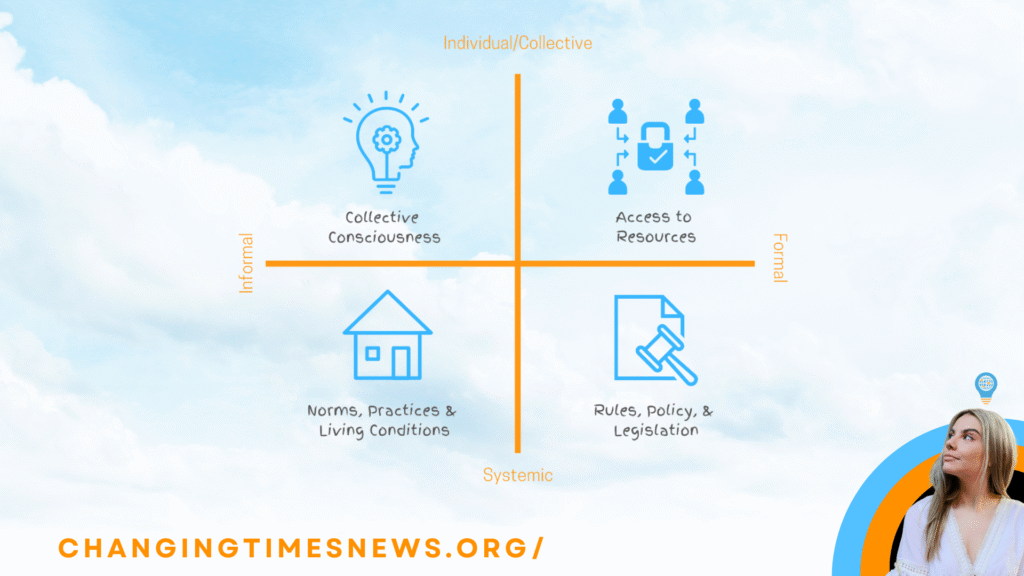
Understanding policy is essential for anyone working toward systemic change. It shapes the conditions in which other forms of change—cultural, economic, organisational, and community-led—take place. At the same time, policy is rarely the starting point. Cultural shifts, social movements, experimentation on the ground, and changes in public imagination often create the conditions that make policy change possible in the first place.
For changemakers, the challenge is not to choose between policy and other approaches, but to see how they interact. Policy can lock in gains, scale solutions, and redistribute resources. But it works best when it is informed by lived experience, supported by public trust, and aligned with deeper cultural change.
Policy matters. It just doesn’t act alone.