There’s a subtle but important distinction that often gets lost in the social impact space: the difference between creating impact and creating change.
These two terms are used interchangeably all the time. They show up in job titles, organisational missions, funding proposals, and everyday conversations among people working to make the world better. But while they may sound similar, they point to two very different ways of engaging with the problems we face—and two very different roles in shaping the future.
Understanding that difference doesn’t mean choosing one over the other. It means recognising that both are essential.
What Do We Mean by Social Impact?
Social impact is, at its core, about making things better within the system as it currently exists. It focuses on improving people’s lives in immediate and tangible ways. This might look like delivering services, supporting individuals and communities, or meeting urgent needs that cannot be ignored.
The work of teachers, nurses, social workers, and community organisations all falls into this category. These are people who are creating meaningful, positive change in people’s lives every day. Their work matters because people are navigating real challenges in real time, and they need support, care, and dignity in the present moment.
One of the defining features of social impact work is that it often operates on shorter timeframes. The outcomes can be seen relatively quickly. A program might improve wellbeing within weeks, or a service might provide immediate relief to someone in crisis. However, while this work improves conditions, it does not always address the deeper causes of those conditions.
What Do We Mean by Social Change?
Social change, by contrast, is about transforming the conditions that created those problems in the first place. It goes beyond responding to issues and instead asks why those issues exist at all.
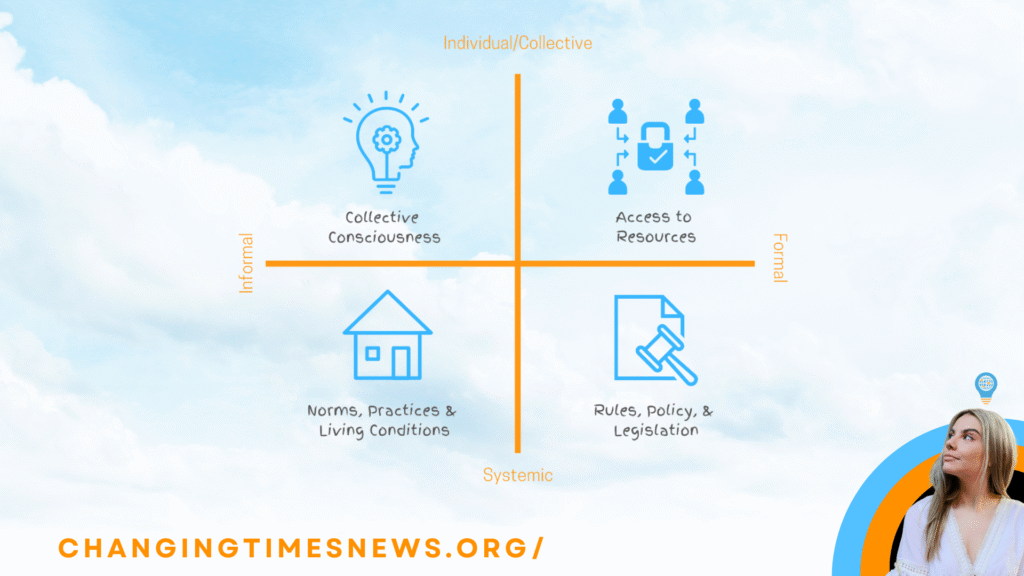
This type of work is focused on shifting systems, structures, and underlying dynamics. It might involve changing policies, influencing legislation, building social movements, or reshaping cultural norms. Rather than working within the system, social change work is about working on the system itself.
Because of this, social change tends to unfold over much longer time horizons. It often takes years, decades, or even generations to see the full effects. Unlike impact work, which can produce immediate and visible outcomes, change work is often slower, less predictable, and harder to measure in the short term.
The Burning House Analogy
A simple way to understand the relationship between impact and change is through the analogy of a burning house.
If a house is on fire, what matters more: rescuing the people inside, or putting out the fire?
The answer is both.
Rescuing people without addressing the fire means the danger continues. Putting out the fire without rescuing people ignores the immediate risk to human life. Both actions are necessary, and neither can replace the other.
This is exactly how social impact and social change function in the real world. Impact work is what supports people in the moment, while change work is what prevents the same problems from continuing in the future.
Why the Distinction Matters
The distinction between impact and change becomes particularly important because people often value one over the other, sometimes without realising it. Some are naturally drawn to work that produces immediate, visible outcomes, while others are more motivated by long-term transformation and systemic thinking.
At times, this can create tension. People working on systemic change may feel frustrated by work that does not address root causes. Meanwhile, those working in service delivery may struggle to see the value of efforts that take years to produce results.
However, framing this as a competition is unhelpful. Both types of work are necessary, and each addresses a different part of the same problem.
The Risk of Focusing on Only One
When we focus only on impact, we risk becoming stuck in a cycle of managing problems without ever reducing them. We continue to support people within systems that keep producing inequality, injustice, or harm.
On the other hand, when we focus only on change, we risk becoming disconnected from the lived experiences of people who are navigating those systems right now. It becomes easy to prioritise long-term transformation while overlooking immediate human needs.
Neither approach is sufficient on its own. Real progress requires both.
Two Roles Within the Same System
Rather than seeing impact and change as separate or competing approaches, it is more useful to understand them as two roles within the same system.
Impact work responds to current conditions and provides support to people living within those conditions. Change work, on the other hand, focuses on reshaping those conditions so that the same problems occur less frequently—or not at all.
These two forms of work are deeply interconnected. In many cases, impact work provides the insights and lived experience that inform change efforts. At the same time, change work creates the conditions that reduce the need for impact work over time.
Different Types of Work, Different Ways of Thinking
The distinction also matters because the nature of the work itself is fundamentally different .
Impact work is often structured and programmatic. It tends to involve clear processes, defined roles, and measurable outcomes. There are established ways of working, and success is often assessed through specific metrics or targets.
Change work, by contrast, is far more adaptive and uncertain. It involves navigating complexity, building relationships, and experimenting with new approaches. Progress is rarely linear, and outcomes are not always immediately visible.
Both require skill, but they demand different mindsets. One is grounded in delivery and consistency, while the other is grounded in exploration and transformation.
Valuing Both Forms of Work
One of the most unhelpful dynamics in the social change space is the tendency to elevate one type of work over the other. Service providers are sometimes dismissed for working within systems, while activists and system changers are sometimes criticised for not producing immediate results.
This hierarchy overlooks a simple truth: people need support now, and systems need to change over time.
Both contributions are valid, and both are necessary.
Finding Your Place
For anyone working in the social impact space, the most important question is not which approach is better. Instead, it is about understanding where your work sits and where you feel most aligned.
You might be drawn to direct service and community support. You might be more interested in advocacy and systemic reform. Or you might find yourself working across both in different parts of your life.
All of these roles are needed. What matters is understanding how they fit together, so that your work contributes to a broader ecosystem of change.
Moving Forward
If we want to create a more just and sustainable world, we need to move beyond the idea that we have to choose between impact and change.
Impact without change leaves us responding to the same problems again and again. Change without impact risks losing sight of the people those systems are meant to serve.
Real transformation happens when both are working together.
Because while we are building better systems for the future, people still need care, support, and dignity today.