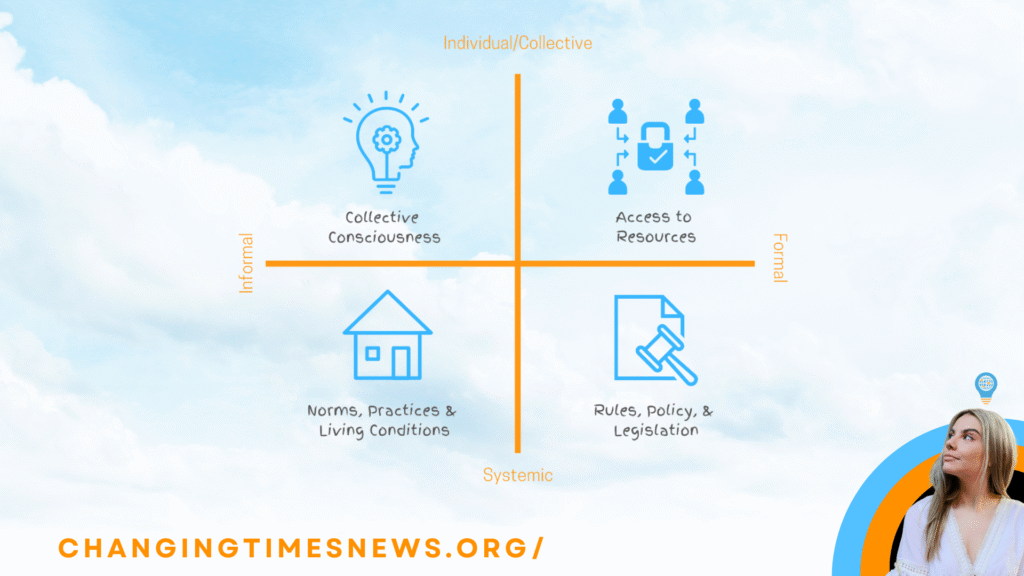
Safety is often discussed as though it is a checklist. Lock your doors. Don’t walk alone at night. Keep your keys between your fingers. Share your location. These fragments of advice circulate constantly, especially among women, yet they rarely add up to something coherent. They can even become exhausting—an endless set of personal precautions that quietly implies the burden of prevention sits with the person at risk.
My conversation with Di shifted that frame.
What she offered wasn’t another list of rules. It was a way of understanding safety as a practice: a set of learnable skills that strengthen self-awareness, improve decision-making under pressure, and (importantly) expand a person’s sense of agency. Her work sits in the security industry, but the underlying ideas apply far beyond it—to leadership, education, public-facing work, community organising, and everyday life.
From “staying hidden” to professional vigilance
Di began with a detail that is easy to miss but crucial for understanding her trajectory. She described growing up shy, shaped by severe childhood eczema and by parents who were also shy. That combination produced a familiar social strategy: stay quiet, stay small, avoid being noticed.
Then she entered security.
At first, security seemed compatible with that instinct. Observing. Watching. Staying in the background. But real-world security work—particularly close personal protection—forces a different kind of presence. It demands assertiveness, clear boundaries, and rapid judgement calls. Even without direct confrontation, de-escalation requires a person to speak with calm authority, to manage their own nervous system, and to read the social environment accurately.
What struck me here is the way Di’s “shyness” didn’t disappear; it was transformed. The observational orientation that once served concealment became professional vigilance. The same attentiveness that might keep a shy child quiet can, with training, become a sophisticated form of situational awareness. This is an important reminder that traits we label as weaknesses are often raw material—capabilities that shift once the context and purpose change.
Understanding the security landscape
Di’s description of the different types of security work matters because it makes visible what the public usually collapses into a single stereotype. Crowd control (“bouncers”) is the most culturally legible form of security, but it is only one domain. Di pointed to:
- Close personal protection (bodyguard work), where ongoing risk assessment is foundational.
- Crowd control, where the primary task is managing group behaviour, movement, and escalation risks.
- Asset protection, focused on safeguarding valuable goods and infrastructure.
- Cash-in-transit, involving high-risk logistics and transport.
- Patrol work, often involving routine monitoring, deterrence, and response.
This matters because when people picture “security”, they often picture physicality alone. Yet Di repeatedly returned to cognition: scanning environments, reading people, anticipating risk, and making decisions under uncertainty. The work is as much about perception and communication as it is about strength.
The “Drake moment” and what the internet missed
Di’s viral moment—being singled out by Drake during a concert in Perth—became a public story almost instantly. But the narrative the internet preferred was telling: “Drake got rejected.” “He got shut down.” The celebrity framing took over, and the incident was treated as entertainment.
Di’s interpretation was more precise, and more socially revealing.
She reframed the interaction as a boundary moment between a man and a woman, stripped of celebrity. She said “yes, I’m married”, and he walked away without aggression or persistence. In her professional lens, that is a successful interaction. The boundary was stated. It was respected. No escalation occurred.
What disturbed her was not the moment itself. It was the reaction: men online defending Drake as though his ego required protection, posting comments that implied she would “regret” it, projecting entitlement into a situation where the actual person involved accepted the boundary and moved on.
This is worth pausing on. It shows how cultural scripts can be more aggressive than individuals. Sometimes the person in front of you respects “no”, but the surrounding culture treats “no” as humiliation, and therefore as something that must be avenged or corrected. That cultural story is one of the reasons safety is not only an individual issue. It is also a collective meaning-making problem.
Di’s phrase captured the alternative story succinctly: “No is not a rejection. It’s a redirection.” That language matters because it shifts the emotional logic. It reduces the likelihood of boundary-setting being read as an attack. And it offers a relational model that many adults were never taught.
Safety, agency, and the “first responder” mindset
The most practically useful contribution Di made was her SAFE framework, which she described as a simplified structure women can apply in everyday contexts—not just high-risk environments. SAFE is:
- Scan for information: gather cues about the situation, person, or environment.
- Acknowledge your emotions: treat feelings as data, reduce their intensity through naming, then assess them as facts to work with.
- Find your response: decide what action is appropriate, including whether escalation to someone else is needed.
- Engage or escalate: follow through—because insight without action can trap a person in unsafe patterns.
I find this framework compelling because it connects three things that are often separated: perception, emotion, and action. Many people either over-trust emotion (reactivity) or under-trust it (dismissal). Di’s approach makes emotions part of the evidence base without letting them dictate the entire response. That is psychologically sophisticated, but it is communicated in accessible language.
It also addresses a common problem in safety education: people may recognise risk but freeze at the point of decision. SAFE tries to bridge that gap by making follow-through part of the method rather than an afterthought.
Situational awareness is not a talent; it is a practice
Di’s account consistently resisted the idea that safety skills are innate. She described situational awareness as something built through repetition until it becomes automatic. In close protection work, every new room and every new person requires a fresh assessment. The practice becomes embodied.
What I take from that is this: self-protection is not only about what you know, but about what you can access under stress. In high-pressure environments, cognition narrows. People revert to habits. That is why practising awareness in ordinary settings matters—so it can be available in extraordinary ones.
Her suggestion to observe people’s body language, tone, and emotional state—and to practise empathy as a way of “reading” situations—may sound simple, but it is the basis of many de-escalation models. It is also a key leadership skill. Leaders who can sense a room, identify escalation cues early, and respond without humiliation or force can often prevent crises before they form.
De-escalation as relational leadership
Di’s de-escalation approach is fundamentally relational. She described delaying “the problem” to first reduce emotional heat. If someone is already flustered, direct correction can intensify conflict. Instead, she advocates connection first—tone, conversational entry, and an attempt to understand what is happening for the person—so that guidance becomes easier to accept.
This approach maps closely onto what conflict research often suggests: escalation thrives on threat, shame, and status challenge. De-escalation works by reducing perceived threat and preserving dignity, even while setting firm limits.
In practice, her method implies:
- Maintain a calm tone and controlled pace.
- Avoid immediate accusations or commands when someone is emotionally activated.
- Use empathy strategically—not as indulgence, but as a pathway to compliance without force.
- Lead the interaction so the person moves in the desired direction “without even realising” they’ve been redirected.
It is a form of leadership that does not rely on domination. And that is precisely why women can excel in it.
Women in protective roles and the burden of being “unexpected”
A repeated challenge Di described was not being taken seriously in male-dominated spaces. Not being looked at. Not being registered as a legitimate presence in the room. This is familiar across industries, but it has a distinctive edge in security because the public often assumes protection is inherently masculine.
Di responded by reframing women as “natural protectors” with strengths that are highly relevant to modern security: emotional intelligence, empathy, communication, and the ability to pre-empt escalation. Whether one agrees with the language of “natural” differences or prefers to read these skills as socially cultivated, her point stands: protection is not reducible to intimidation. In many contexts, intimidation is precisely what makes situations worse.
What stood out was her emphasis that women can “make things happen” without ruffling feathers. That is not submissiveness. It is tactical competence.
What male allies can do beyond good intentions
Di’s praise for her husband’s role was not generic appreciation. It was specific: he was vocal, explicit, and public in affirming her authority. He named her role. He pointed to her experience. He used her as a positive example in staff contexts.
That specificity matters. It suggests that “welcoming women” is not a private belief; it must be enacted through recognition and amplification. Di made a point that aligns with what research on gender and authority often shows in practice: when men in leadership positions publicly validate women’s competence, others are more likely to follow—particularly in environments where masculine norms are dominant.
Her advice to men was strikingly simple: acknowledge the woman in the room. Include her voice. Be explicit about her authority before the room decides to erase it.
Safety and confidence: a feedback loop
Near the end, Di directly addressed the relationship between safety and confidence. Her answer was clear: confidence grows through self-awareness and risk assessment because those skills reduce dependence on external protection. When you can assess a situation, identify a problem, and act, your confidence is no longer reliant on someone else arriving to save you.
This is one of the most important social implications of her work. Safety is not only about preventing harm. It is also about expanding a person’s perceived range of action in the world. That is empowerment in its most concrete form.
And it connects deeply to broader gender justice questions. In my own research and work, I have repeatedly seen how constrained mobility and constrained safety reduce women’s opportunities—education, employment, civic participation, and leadership. When safety practices increase agency, they become not only protective but developmental.
Teaching safety to young people without manufacturing fear
Di’s suggestions for parents and educators were careful. She emphasised conversation, not paranoia. She encouraged adults to admit their own mistakes and vulnerability rather than presenting themselves as perfect authorities. This matters because children and adolescents are more likely to disclose difficult experiences when they believe adults can tolerate complexity without judgement.
She also suggested scenario discussions—using news stories or everyday situations as prompts—without expecting “the right answer”. The point is to build reflective capacity, not compliance.
Her final point was relational and community-focused: reduce isolation. Create spaces of connection. Encourage young people to help others, because prosocial action can reduce the sense that their own anxieties are all-consuming. That aligns with a broader literature on belonging and resilience: community is not a “nice extra”; it is often a protective factor.
The deeper takeaway
What I found most meaningful in Di’s contribution is that she refuses the false split between personal safety and collective responsibility. She does not deny structural problems. She simply insists that individuals can build skills that reduce vulnerability, increase clarity, and strengthen boundaries.
That insistence is not victim-blaming when it is framed properly. It becomes agency-building. It becomes competence-building. It becomes a form of everyday leadership.
Di’s message, at its core, is this: safety is not just something you hope to have. It is something you can practise.
And for many women, that shift—towards self-awareness, boundary confidence, and deliberate action—can be life-changing.