In the latest episode of Changemaker Q & A, host Tiyana J tackles a critical yet often muddled trio of terms in the field of social change: systematic, systemic, and systems change. While the words may sound similar, she argues they describe very different pathways—and conflating them can obscure the strategies needed for lasting impact.
Getting the terms straight
Systematic change, as Tiyana explains, refers to how change is done—an organized, methodical, step-by-step process. It’s about planning, structure, governance of actions. For example, a local council tackling homelessness might follow a sequence: survey how many people are sleeping rough, coordinate shelters, distribute meals, track outcomes—all in a structured fashion.
Systemic change (what many people mean when they say “system change”) refers to where change is happening—namely to the formal structures of society. Tiyana gives the case of homelessness again: reforming housing policy, adjusting welfare payments, enshrining tenant protections in law—those are systemic interventions. External sources define systemic change as addressing root causes and changing the conditions that hold a problem in place. thecatalyst.org.uk
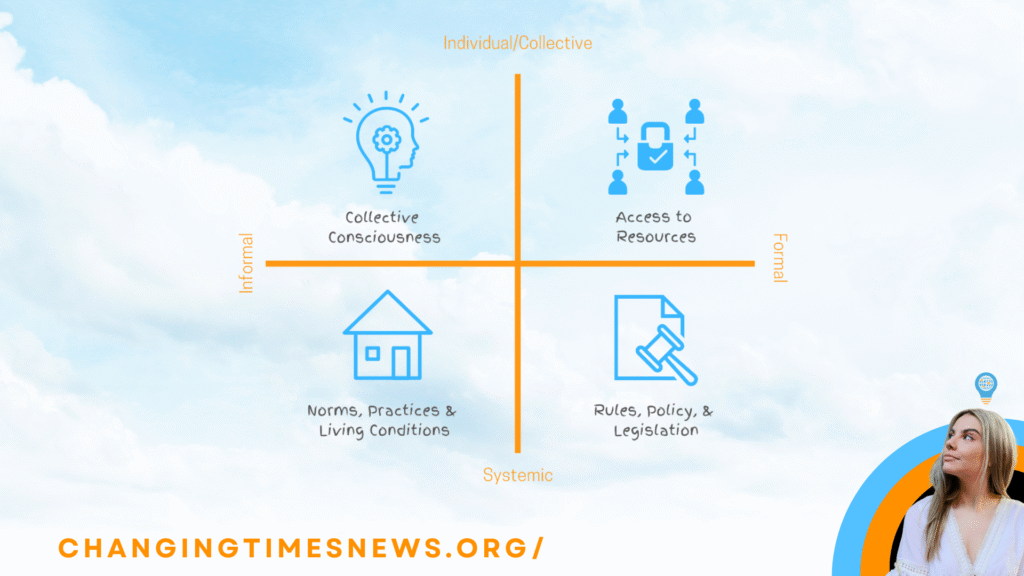
Systems change is the broadest terrain: it describes a way of thinking and acting that addresses the entire interconnected web of formal structures, informal behaviours, relationships, norms, flows of resources and information. Tiyana says a systems change approach recognises homelessness not only as an outcome but as part of a larger, dynamic system of interactions—policies, perceptions, community networks, funding flows, cultural narratives. In external literature, “systems change” is defined as shifting component parts of a system and the pattern of their interactions so the whole behaves differently.
| Term | Focus | Approach | Homelessness example |
|---|---|---|---|
| Systematic | Process (how) | Structured, step-by-step, data-based | Count sleeping-rough numbers → set up shelters → meals → track outcomes |
| Systemic | Formal structure (where) | Policy, institutional reform, governance frameworks | Reform housing policy, welfare payment adjustments, tenant-rights legislation |
| Systems change | Whole system (what) | Holistic, interconnected, adaptive, cross-sector | Combine policy reform with public narrative shifts, networked service delivery, addressing root-causes and mental models |
Why this matters for social change work
Tiyana emphasises that for change-makers in policy, community development, organisational change or social impact generally, the distinction is not mere semantics: it changes what strategy you deploy, how you measure success, and how long it might realistically take.
- A systematic approach brings clarity, accountability, measurability. It suits interventions where process matters: e.g., a shelter-program or education initiative.
- A systemic approach addresses formal levers of power, policy, institutions. It often requires longer time-horizons, broader stakeholder alignment.
- A systems change approach is arguably the most ambitious: tackling complexity, shifting norms, relationships, power flows. It demands collaboration across sectors, continuous adaptation, recognising unintended consequences. External sources note that systems change must engage multiple actors, accept uncertainty, map interconnections.
Tiyana observes in her teaching of a Systems Thinking course that many students default to systemic change thinking when what is actually needed is a full systems change approach. In other words, they focus on institutions and policy but neglect informal elements such as culture, attitudes, information flows, and community networks—elements essential to systems change.
In a world of increasing complexity and intersecting social challenges—whether homelessness, climate justice, public health or organisational transformation—it can be tempting to reach for a generic call for “system change”. But as Tiyana J artfully argues, the power of our work is strengthened when we clearly understand what kind of change we are aiming for: the process (systematic), the structure (systemic), or the whole system dynamics (systems change).
Getting that distinction right doesn’t just sharpen our language—it shapes our strategy, sets realistic expectations, and opens the door to deeper, more sustainable impact.
For those interested in taking a deeper dive into the systems thinking frameworks referenced in the podcast and the handbook Opening the Black Box, you’ll find pointers in the episode’s show notes. And if you’d like to engage further, join Tiyana’s Q & A forum via the School of Social Impact.