In a provocative new episode of Change Maker Q&A, host Tiyana J turns a spotlight on a persistent tension in social change: when massive public mobilisations fail to shift policy quickly, how much is culture to blame — and can culture be the foundation for deeper transformation?
The episode begins with a deceptively simple question: How much influence does public perception or cultural norms really have on shaping social change, given that mass demonstrations often fail to produce immediate policy shifts? That question surfaced over a casual conversation in Canberra and reemerged in a systems‐thinking class at ANU. It asks whether cultural transformation is a real lever — or merely the soft underbelly of activism.
Tiyana J is not dismissive of policy. Legislative change, after all, is visible, measurable, and often the mode by which we narrate “progress.” But in her view, that focus obscures a deeper truth: policy and culture move on different timelines. While law can shift within legislative sessions, culture evolves across generations. The symbolic, the narrative, the normative — these are slow, intangible, but also the bedrock upon which durable change is built.
What We Mean by “Culture”
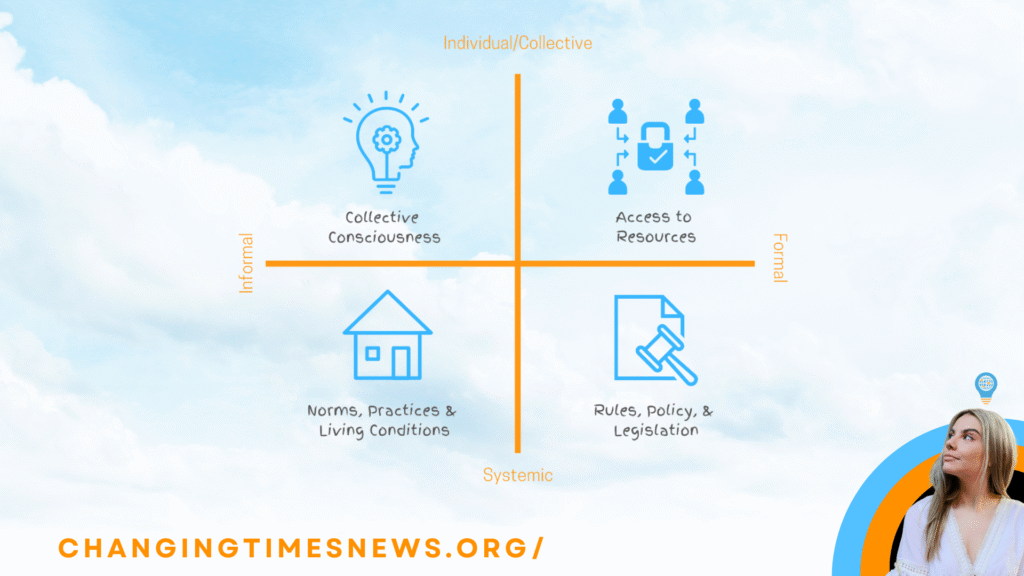
One of the strongest contributions of the episode is how it parses culture into (somewhat) tangible building blocks. Culture is more than gestures or arts — it’s the values, attitudes, mental models, worldviews, norms, symbols, and institutions through which communities perceive what is legitimate, desirable, or possible.
- Values act as moral cores, shaping what societies deem good or just.
- Attitudes are how we apply those values to concrete issues.
- Mental models and worldviews provide the deeper frames through which societies interpret reality.
- Norms, symbols, rituals, beliefs, and institutions are the mechanisms through which culture is enacted and reproduced.
With those conceptual tools, Tiyana urges us to see culture not as an epiphenomenon but as a political force in its own right — one that both constrains and enables policy.
Structure, Agency, Culture: A Three-Way Dance
To navigate the interplay between individual action (agency), institutional architecture (structure), and cultural norms, Tiyana draws on a tradition of social theory — especially Margaret Archer’s morphogenetic approach. Archer’s framework insists that culture is not reducible to policy or individual will; instead, culture operates in a domain of its own, interacting with structure and agency in a temporal sequence. SpringerLink+2Cambridge University Press & Assessment+2
In Archer’s view, agents (individuals and groups) are conditioned by preexisting cultural and structural contexts (T1), then act reflexively (T2–T3), and finally produce outcomes that either reproduce or transform those contexts (T4). By treating structure, agency, and culture as analytically distinct, Archer avoids collapsing one into another. PhilPapers+2Critical Realism Network+2
This framing allows Tiyana to argue that social change is not a contest between policy vs culture; it’s a dialectical process. New policies are rarely accepted unless they resonate with evolving cultural frames, and new cultural frames often need legal or institutional backing to scale and stabilize.
Culture as the Deep Leverage Point
To illustrate culture’s strategic importance, Tiyana invokes a favorite systems‐thinking metaphor: the iceberg model. Policy is the visible tip; culture lies submerged, behind trends, structures, and the deeper mental models that sustain them.
She also draws on Donella Meadows’s concept of leverage points in complex systems — places where a small shift can lead to outsized change. Crucially, the deeper the leverage point (paradigms, goals, worldviews), the more transformative — but also the harder to affect.
Therefore, Tiyana argues, social change strategies that aim only at policy (a shallower lever) are necessary but insufficient; enduring transformation must aim at paradigms and narratives (deeper leverage). In other words, policymakers and activists must treat culture not as background noise, but as a site of contestation and intervention.
When Policy Fails to Stick: A Cautionary Tale
One of the episode’s sharpest examples comes from Queensland’s recent reversal on pill testing. Although pill testing had been introduced to improve safety, the incoming government rescinded it, aligned with a “tough on crime” cultural narrative. The policy had no traction because it was disconnected from prevailing moral frames and identities — culture undermined the legislation. In Tiyana’s telling, it is a cautionary tale: policy without cultural resonance is vulnerable.
Rethinking Strategy: Culture-First Tactics
If culture is this potent — yet slow and slippery — what can change-makers do? Tiyana suggests:
- Narrative change: Elevate new collective stories that reshape how social issues are understood (e.g. reframe climate change as justice).
- Symbolic action & art: Use protests, rituals, art to challenge dominant assumptions and open space for new meanings.
- Transform everyday practices: Cultural transformation is rooted in daily life — consumption, relationships, habits.
- Institutional embedding: Laws are more stable when they resonate with underlying cultural frames (education, media, religion).
In her framing, policy is never unimportant — but when deployed without cultural backing, it is shallow and brittle.
Why Culture Remains the Forgotten Frontier
Tiyana ends by reflecting on why culture is so often neglected:
- It is less tangible than law, harder to measure and evaluate.
- It unfolds slowly, often beyond funding cycles.
- It is deeply contested — efforts to change culture often provoke strong backlash because they threaten identities.
- It is complex and multi-layered; intervening in culture means engaging in symbolic, ideological, institutional, and narrative work.
What This Means for Social Movements
This episode is a call to shift how we think about social change. Mass marches, policy briefs, lobbying — these remain essential — but they should be integrated into a broader cultural strategy. Movements must view themselves as narrative engineers, culture shapers, slow agitators. Otherwise, they risk producing transient laws that evaporate when political winds shift.
In a world where change feels urgent, Tiyana’s message is timely: policy may deliver quick wins, but it is culture that changes hearts and minds — and in the long run, that is what holds societies together.