Sometimes the most useful social change conversations are not the polished, highly structured ones. Sometimes they are the messy, honest, wide-ranging questions people ask when they are trying to find their footing: What should I study? Am I aiming too big? Where do I even begin? What should I read?
This episode of Changemaker Q&A took a rapid fire approach to exactly those kinds of questions. Rather than doing a deep dive into one topic, it moved across some of the most common uncertainties that people face when they are entering the social impact space or trying to find their direction within it.
What emerged was a set of practical reflections on education, systems thinking, personal development, and the kinds of learning that happen far beyond books and classrooms.
To skip the HCN Weekly Brief start at 7:17
Not every “social justice” degree is the best starting point
One of the first questions tackled in the episode came from a listener considering a university degree in social justice. On the surface, it sounds like an obvious fit for someone who wants to create change. But the answer pushed back on that assumption.
The concern was not that social justice is unimportant. It absolutely is. The concern was that social justice is only one lens through which to understand society and social problems. It highlights power, inequality, exclusion, and structural injustice, which are all essential. But it is still only one lens.
If changemakers only learn to interpret the world through one normative frame, they risk limiting their ability to understand the full complexity of the systems they are trying to change. Other lenses matter too: resilience, sustainability, peace, ecology, culture, development, and more. Each one reveals something different about what a problem is, why it exists, and what a meaningful response might look like.
The deeper point here is not really about one particular degree. It is about breadth. A good foundation for changemaking often comes from learning how to think across disciplines and across frames, rather than narrowing too early into one specific ideological or analytical approach.
That might mean studying something broad like sociology, anthropology, philosophy, psychology, development studies, or a general arts degree, then using electives, minors, or later specialisation to develop a more defined direction. The goal is not to avoid strong values. The goal is to avoid being trapped inside only one way of seeing.
The best advice for new changemakers: start a garden
Perhaps the most unexpected answer in the episode was also one of the strongest. When asked what one thing every new changemaker should do, the answer was simple: start a garden.
At first, that might sound like a quirky detour from the serious work of strategy, politics, or systems change. But the reasoning behind it is powerful.
Gardening teaches lessons that no textbook can. It teaches observation. It teaches patience. It teaches adaptation. It teaches humility. It teaches that you can do many things right and still have seeds fail to sprout. It teaches that outcomes are always shaped by context: climate, timing, soil, insects, light, water, care, and chance.
Most importantly, it teaches that change is not linear.
A garden is never static. It is an unfolding process shaped by continuities, discontinuities, and emergence. Some things persist. Some things disappear. Some entirely new things arise. That is also how social change works. It is not a neat sequence of inputs leading to predictable outputs. It is a dynamic unfolding of possibility within particular contexts and conditions.
For people just starting out in changemaking, gardening can be a way of learning to think ecologically rather than mechanically. It helps shift people away from the modern habit of wanting to control everything through abstract plans and toward a more grounded understanding of participation, care, and feedback.
That does not mean books and courses are unnecessary. It means the deepest lessons about change often come through lived practice.
Feeling overwhelmed by systems change is normal
Another listener asked a question many people quietly carry: if the type of change I want to create is systemic, and I feel totally overwhelmed by it, should I just focus on something smaller and more realistic?
The response made an important distinction between three terms that are often used interchangeably even though they mean very different things: systematic change, systemic change, and systems change.
A systematic approach refers to how we work. It means being strategic, structured, deliberate, and process-driven.
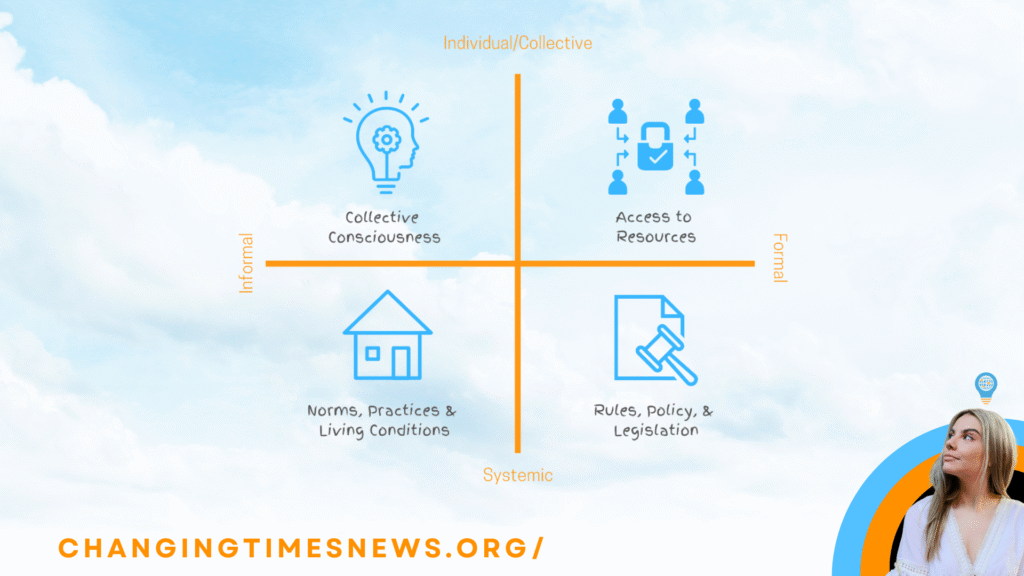
Systemic change usually refers to changing formal structures within society, such as laws, policy, institutions, and regulations.
Systems change refers to shifting the broader complex system itself, including feedback loops, incentives, mindsets, relationships, resources, cultural norms, rules, and goals.
That distinction matters because many changemakers say they want to create “systemic change” when what they actually mean is either policy change or systems change. These are different projects, with different timelines, methods, and expectations.
The key message was that feeling overwhelmed by this kind of work is entirely normal. Complex systems are, by definition, complex. No individual can control them, and no single action will transform them. But that does not mean your work is unrealistic or pointless.
It means your task is to understand the system well enough to locate where your work fits. Your project may not “change the whole system” on its own, but it can contribute to the conditions that make wider transformation possible. It might generate knowledge, build capacity, shift narratives, change incentives, create new resources, or strengthen a movement. Those are not side tasks. They are often the preconditions of larger change.
The advice here was not to lower your ambition. It was to deepen your understanding. Learn the system intimately. Know which part of it you are trying to influence. Get clear on your theory of change. Understand the relationship between your actions and the kind of shift you are hoping to support.
That is how overwhelming aspirations become strategic contributions.
Books matter, but curiosity matters more
The final major question explored in the episode was about books. Which books should changemakers read?
Rather than giving a neat top-ten list, the response offered something more useful: the recognition that the “right” books depend on the kind of changemaker you are becoming, the work you are drawn to, and the questions that are alive for you right now.
There are certainly authors and bodies of work that can serve as strong anchors. Joanna Macy’s Work That Reconnects was highlighted as life-changing, particularly for understanding emotional resilience, ecological connection, and the deeper dimensions of social change. adrienne maree brown’s work, especially Pleasure Activism and Emergent Strategy, was recommended for people interested in activism, relationality, decentralised transformation, and new ways of thinking about movement work.
But the broader point was that reading should not become a performance of being “well read” in the social impact space. It should be an extension of curiosity. The books that genuinely shape us are often the ones we encounter because something in us is already moving toward them.
There was also an implicit invitation here to read widely. Memoir can be just as transformative as theory. Gardening books can teach as much as policy books. Philosophy, feminism, ecology, spirituality, history, and storytelling all have something to offer changemakers.
The challenge is not just to consume information. It is to let reading deepen the way we see.
A wider lesson: changemaking is both inner and outer work
What tied the whole episode together was not the specific questions themselves, but the worldview underneath the answers.
Changemaking is not just about having good intentions or taking action. It is about learning how to perceive the world with greater depth. It is about becoming someone who can navigate complexity without collapsing into simplicity. It is about building both analysis and intuition, both strategy and patience, both theory and lived practice.
That is why a question about university can lead into a discussion about worldviews. Why a question about starting out can lead to a garden. Why a question about systems change can become a lesson in theory of change. Why a question about books can become an invitation to follow curiosity rather than someone else’s reading list.
For emerging changemakers, this is an encouraging reminder. You do not need to have everything figured out. You do not need to start with a perfect degree, a flawless five-year plan, or a complete understanding of every system you care about.
But you do need to keep learning. You do need to observe closely. You do need to take your own questions seriously. And you do need to become the kind of person who can sit with complexity without rushing to easy answers.
That is not rapid work. But it is real work. And over time, it is what allows changemaking to become not just something you do, but a way of being in the world.